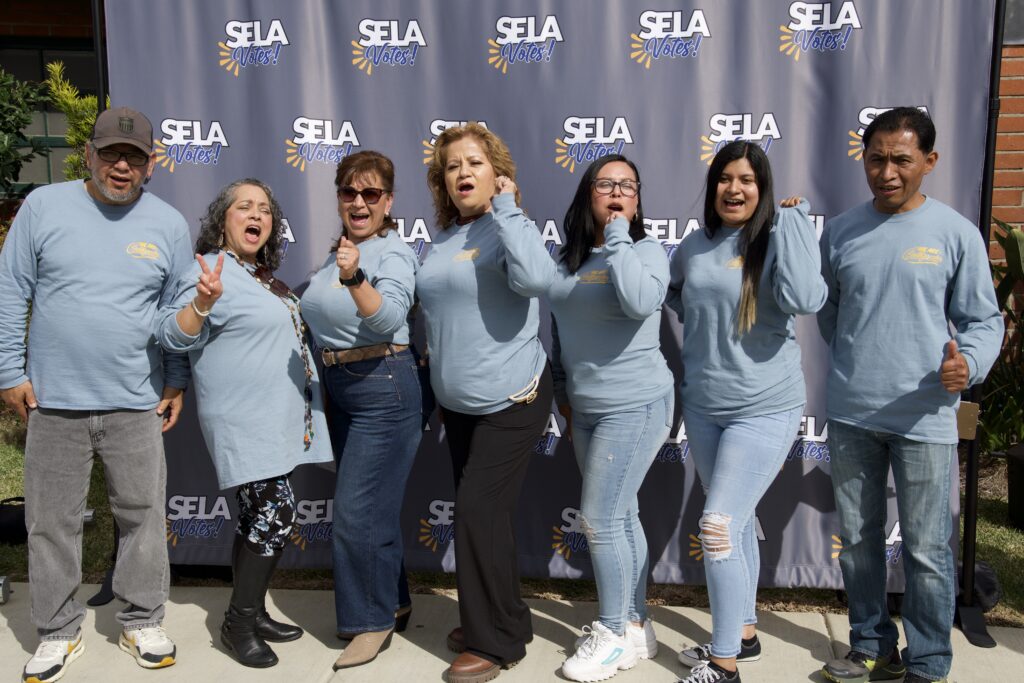
Su voto vale más que oro.
If we don’t vote, someone else decides for us.
Our 2026 Voter Guide
This November, the decisions on your ballot will shape our neighborhoods for years to come.
Latinas/os are the heart of LA County. We’re the largest group in 48 of its 88 cities, 62.5% of K-12 students, and more than 40% of the workforce. When our community thrives, all of LA thrives.
Our voter guide explains each statewide proposition: what it does, how it could affect our communities, and what a YES or NO vote means. For recommendations, visit Somos el Voto, the Alliance for a Better Community Action Fund.
The full voter guide is live on Instagram. Follow, save, and share it! Or scroll down for a quick look at each proposition.

Make a Plan to Vote

Don’t forget these important dates! Whether you vote by mail, early, or on Election Day, every vote counts.
Did you know? In LA County, you can vote at any vote center, not just the one closest to home. Vote near work, near school, or wherever works for you.
Voter Guide at a Glance

Prop 1
Veteran and Housing Assistance Programs Bond Measure
Allows California to borrow $11.25 billion for affordable rental housing, homeownership, farmworker housing, student housing, housing infrastructure, and other housing programs.
“NO” Vote
Would leave the state without new bond funding for housing programs.
“YES” Vote
Would authorize the $11.25 billion bond, giving the state new resources to address housing needs.

Prop 2
Budget Stabilization Account Cap Increase
Allows California to increase its state “rainy day fund” from 10% to 20% of General Fund revenues. The fund is used to help maintain essential services when the economy slows or state revenues decline.
“NO” Vote
Would keep the current 10% cap on the state’s rainy day fund, leaving more revenue for current investments and programs.
“YES” Vote
Would allow California to build a larger rainy day fund, giving the state more financial protection during future economic downturns.
Prop 3
Renew State Income Tax Increase for Education Funding Initiative
Makes California’s existing state income tax on the top 2% of highest-income earners permanent. The measure does not raise taxes, but removes the tax’s 2030 expiration date.
“NO” Vote
Would allow the existing tax on the top 2% of highest income earners in CA to expire in 2030. California would lose this dedicated source of education revenue, reducing significantly the amount of funding available for public schools and community colleges.
“YES” Vote
Makes the existing state income tax on the top 2% of highest-income earners in CA permanent, protecting a critical source of funding that serves as a lifeline for many school districts and community colleges.
Prop 4
Allow Public Financing of Election Campaigns Measure
Allows the state and local governments to create programs that help community candidates run for office without relying as heavily on large private donations. The measure does not require local governments to create the programs; it gives them the option to do so.
“NO” Vote
Would keep the current ban on public financing for state and local campaigns, limiting options for community candidates to access public campaign funding.
“YES” Vote
Would allow the state and local governments the option to fund candidates through public campaign programs, creating another path for community candidates to run for office.
Prop 5
Eliminate State Officer Recall Successor Elections Amendment
Would change the current recall process, where voters decide 1) whether to remove an official and 2) their replacement. Instead, voters would decide only whether to recall the official, with a replacement chosen later through the state’s process for filling vacant offices.
“NO” Vote
Would keep the current system.
“YES” Vote
Would remove the replacement candidate election from the recall ballot, allowing voters more time to consider who should fill the position.
Prop 37
Second Mortgage Homebuyer Program and Revenue Bond Initiative
Creates a $25 billion state program to help eligible CA residents buy a home. Buyers would put down at least 3% and could receive a loan of up to 17% to help reach a 20% down payment on a newly constructed home. The loan would be paid back to the state as a second mortgage, allowing the funds to be reused to help future homebuyers.
“NO” Vote
Would not create a new state homebuyer assistance program or authorize the $25 billion bond.
“YES” Vote
Creates the new homebuyer assistance program, helping eligible Californians purchase a newly constructed home with less money upfront.
Prop 38
Immunology and Immunotherapy Research Funding Initiative
Allows California to borrow $8.4 billion to fund research on the immune system to prevent and treat diseases, including cancer, heart disease, and Alzheimer’s. Half would go to one UC-affiliated research institute, with the rest awarded through competitive grants.
“NO” Vote
Keeps the state from borrowing $8.4 billion for this research.
“YES” Vote
Would allow the state to take on $8.4 billion in new debt to fund immunology and immunotherapy research at California universities and research institutions.
Prop 39
Voter Identification and Citizenship Verification
Prohibits in-person voting without presenting government-issued identification. Rejects mail ballots without the last four digits of a government-issued ID written on the envelope and requires citizenship verification using new and expensive election administration and auditing requirements.
“NO” Vote
A voter’s identity would continue to be established with the voter’s signature.
“YES” Vote
Adds new identification requirements making it harder for eligible voters to cast their ballots.
Prop 40
One-Time Wealth Tax for State-Funded Healthcare, Education, and Food Assistance Programs
Creates a one-time 5% tax on billionaires and certain trusts, with most of the money raised going towards health care.
“NO” Vote
Rejects the one-time 5% wealth tax and its proposed use of revenue.
“YES” Vote
Creates the one-time 5% wealth tax and directs the revenue mainly towards filling healthcare funding gaps.
Prop 41
Special Tax Audits and State Spending Limits
Requires audits of programs funded by new statewide special taxes and limits when this spending can be excluded from the state’s spending limit. For example, if voters approve a new statewide tax to fund health care, the programs funded by that tax would also be subject to state audits.
“NO” Vote
Keeps the current rules for state audits.
“YES” Vote
Requires new audits of programs funded by special taxes and changes how certain new tax revenue counts toward the state’s spending limit.
Prop. 40 connection: If both pass, Prop. 41 could prevent Prop. 40 from taking effect if Prop 41 receives more YES votes.
Prop 42
Limits on Future Taxes on Personal Assets
Limits California’s ability to create “weath” taxes in the future.
“NO” Vote
Keeps California’s ability to consider new wealth and asset-based taxes in the future.
“YES” Vote
Prevents California from creating new wealth and asset-based taxes in the future.
Prop. 40 connection: If both pass, Prop. 42 could prevent Prop. 40 from taking effect if Prop 42 receives more YES votes.
Prop 43
Two Thirds Tax Vote Threshold
Limits voters’ ability to pass voter-proposed local special taxes by increasing percentage of votes needed to approve such ballot measures from a majority (over 50%) to two-thirds, beginning January 1, 2027.
“NO” Vote
Allows local special taxes to continue passing by simple majority vote, giving communities more flexibility to fund local services and programs.
“YES” Vote
Requires local special taxes to receive two-thirds voter approval to pass, making it harder for communities to fund local services and programs.
Prop 44
Spending Requirements for Federally Qualified Health Centers
Requires federally qualified community health centers to spend at least 90% of their annual revenue on a limited set of services, significantly reducing funding for other services that support patients and communities.
“NO” Vote
Keeps current rules and clinic flexibility.
“YES” Vote
Limits clinics’ ability to use resources for essential services such as language access, health care enrollment assistance, transportation, and telemedicine, among other services.
Prop 45
Expedited Environmental Review for Certain Projects
Amends California Environmental Quality Act (CEQA) to speed up environmental reviews for housing, transportation, water, and health projects by setting deadlines for reviews and legal challenges.
“NO” Vote
Keeps current environmental review processes preserving residents’ opportunities to weigh in on projects in their communities.
“YES” Vote
Shortens environmental review and public comment, limits legal challenges, and reduces residents’ ability to weigh in on projects affecting their neighborhoods.
¡Llegaste! You made it to the end!
Muchas gracias for taking the time to learn about what’s on your ballot. That’s what it looks like to show up for your community.
Download the full voter guide for a deeper look at every proposition and what it means for our communities.
Spread the word. Share our voter guide on Instagram and tag a friend who needs it.